If you are evaluating an artificial intelligence project, sooner or later someone will tell you: this needs fine-tuning. The supplier says it, the consultant says it, you read it in articles. Hardly anyone, though, stops to explain what it means.
Yet it is a word that carries weight. Whether or not you need fine-tuning determines the project timeline, the people to involve and the computer to buy.
In this article we look at what fine-tuning is, starting from scratch and without jargon. First a quick refresher: what an artificial intelligence model is and how it learns. Then what it means to specialise it, when it makes sense and what you need to do it in your company.
A quick refresher: what an artificial intelligence model is
A model is a program that was not written as a set of rules, but has learnt from examples.
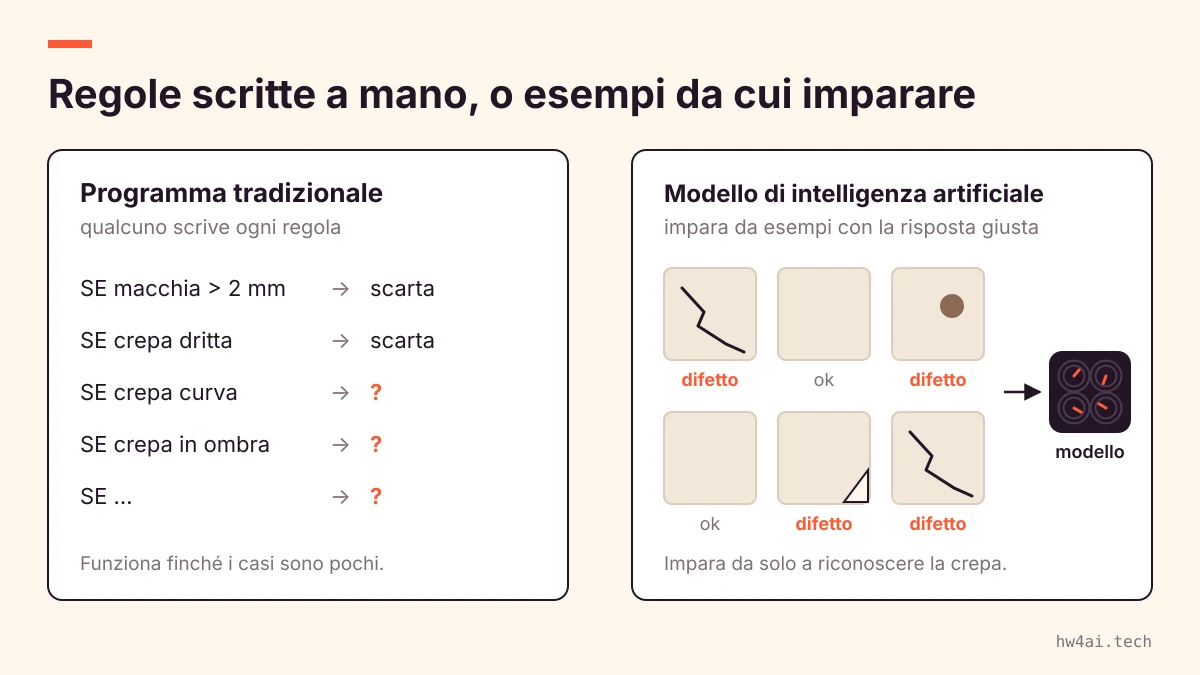
Take the quality control of a part. With a traditional program, someone has to write every rule: if the stain is larger than two millimetres, reject the part. It works as long as defects are few and predictable. But a crack can be straight, curved, thin, in shadow. Writing a rule for every case is impossible.
An artificial intelligence model does the opposite. It doesn’t receive rules: it receives thousands of examples, and from those it learns on its own to recognise a crack.
How it learns: the knobs
Picture the model as a huge audio mixing desk, full of knobs. In modern models there are millions of them, sometimes billions. Specialists call them parameters.
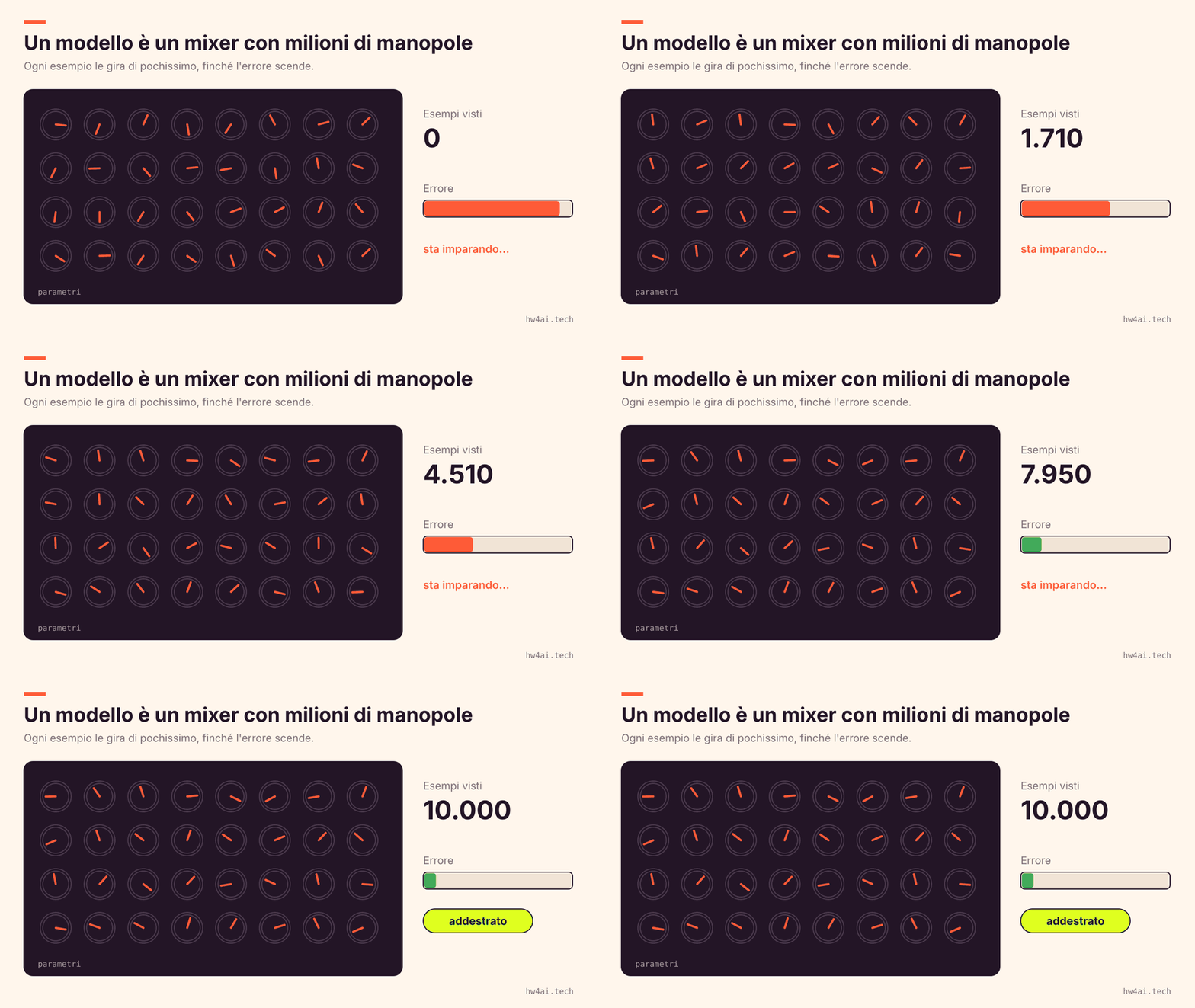
Learning works like this:
- you show the model an example, for instance the photo of a part;
- the model makes a guess: defective or good?
- you compare its answer with the right one;
- if it got it wrong, every knob is turned a tiny bit, in the direction that reduces the error;
- you repeat with the next example, thousands or millions of times.
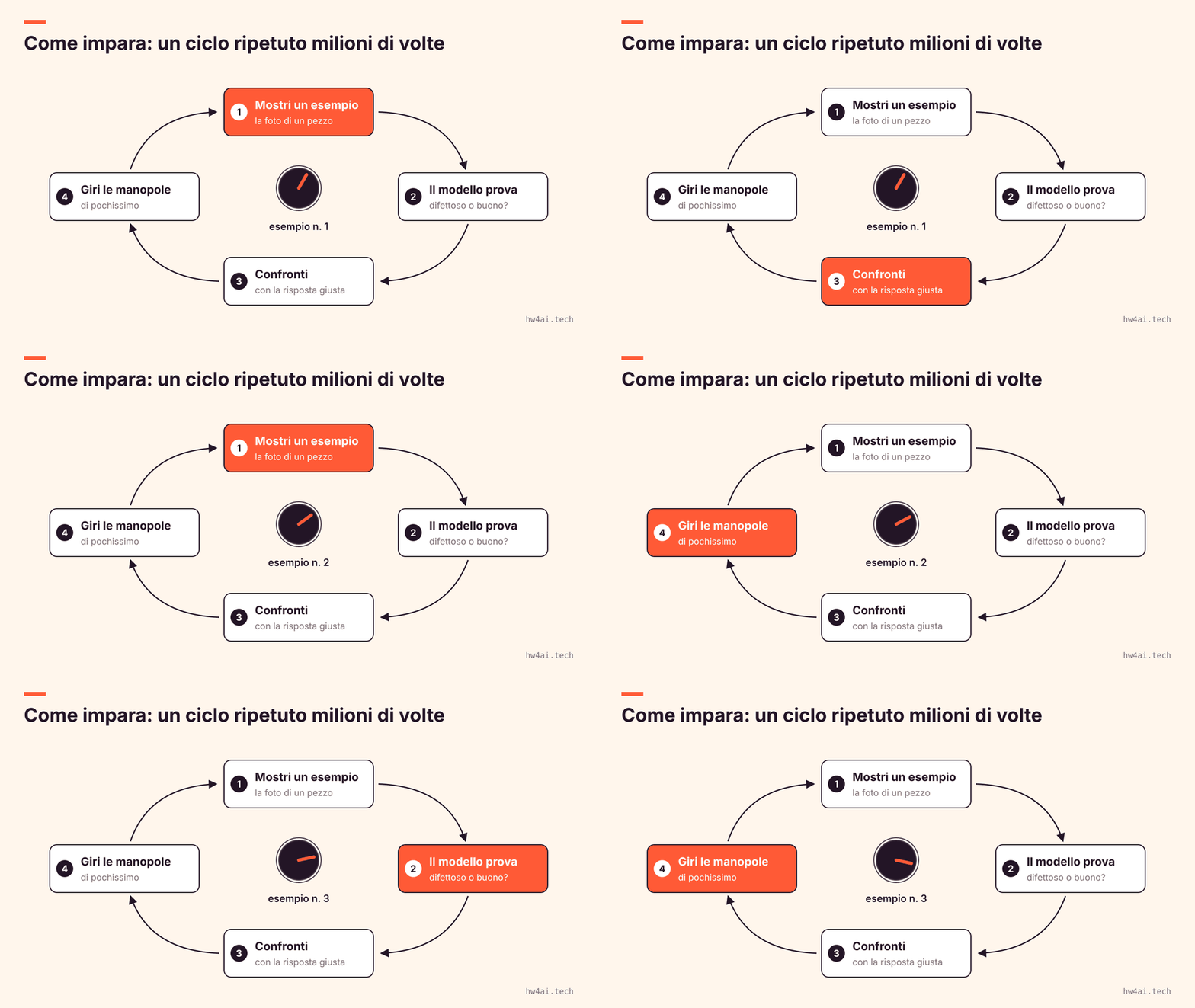
In the end the knobs are set so that the model almost always guesses right. This process is called training.
Two things to remember
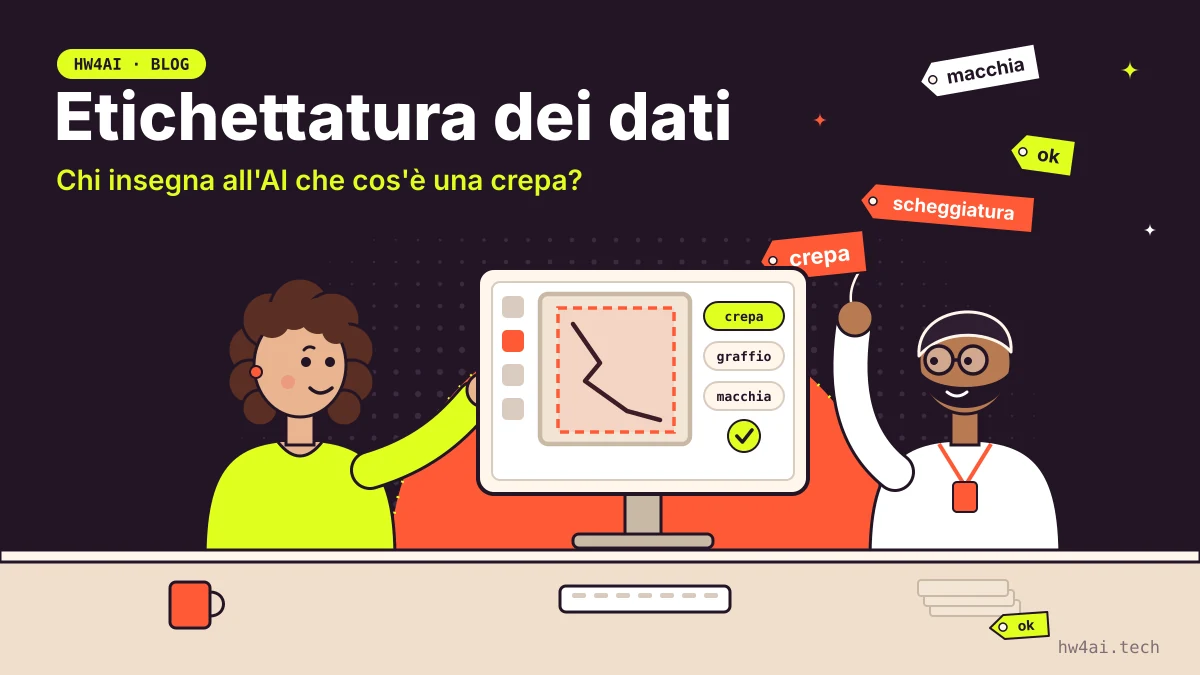
You need examples with the right answer. The model learns by comparing itself with the correct answer. Someone has to say, photo by photo, whether there is a defect and which one. This work is called data labelling and it is done by the people who know the trade.
Learning and working are two different moments. When training ends, the knobs stay still and the model is put to use: it looks at a new part and answers. This everyday phase is called inference. It is a word you will hear often from suppliers, and it is worth knowing.
Why hardly anyone trains a model from scratch
Training from scratch means starting from knobs set at random: the model knows nothing. To recognise a crack it first has to learn what an edge, a shape, a shadow and a surface are. And learning that takes huge amounts of examples and computation.
For the largest models the costs are beyond the reach of any ordinary company. According to Epoch AI’s estimates, the final training run of GPT-4 alone cost about 40 million dollars in computers and energy (Epoch AI).
The good news is that you don’t need to. There are many models already trained by large companies and research centres, and quite a few can be downloaded and used freely. They have seen millions of images or huge amounts of text. They already know the basics: they recognise shapes and objects, they understand and write English.
What they don’t know is your work: your defects, your products, the way your company writes. That is where fine-tuning comes in.
What fine-tuning is: specialising a model that already knows
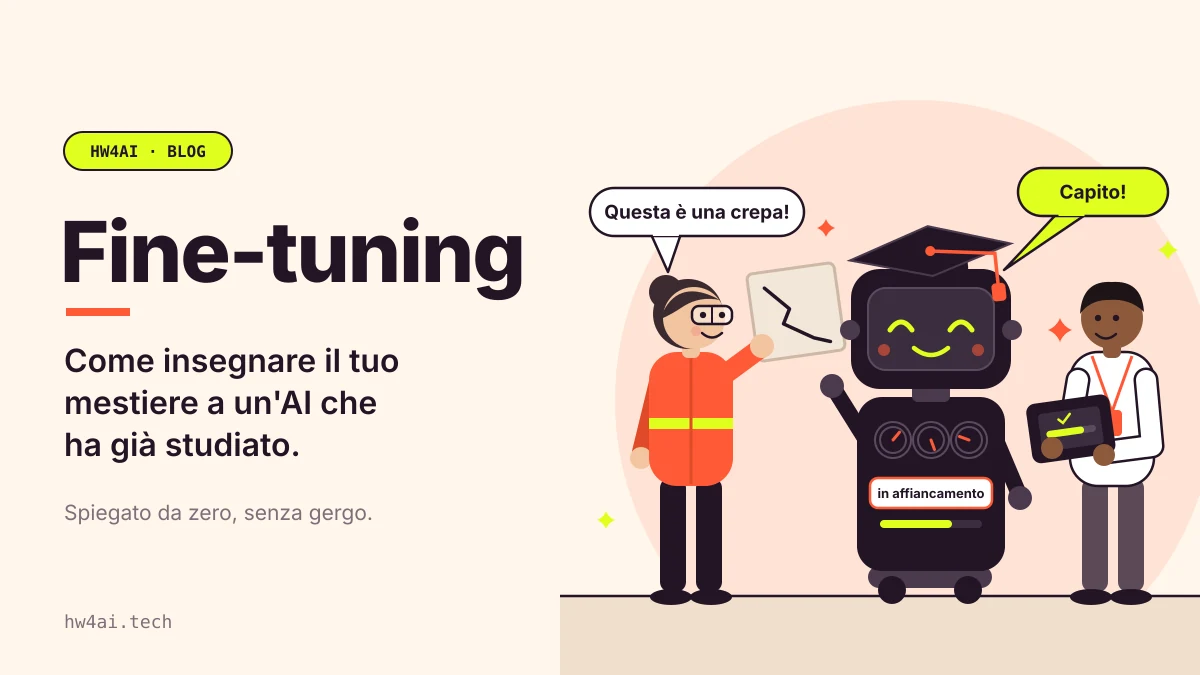
Fine-tuning means taking an already trained model and continuing to train it for a short time, only with your examples. The knobs are already almost in the right place: they are just touched up, enough for the model to learn your task.
The name says exactly that: it is a fine adjustment, not a rebuild. You don’t build the mixing desk, you adjust the last few knobs.
Think about how you bring a new technician into your company. You don’t send them to nursery and then university at your own expense: you hire someone who already has a degree. Then you give them a few weeks of on-the-job training on your products. University is the training, on-the-job training is fine-tuning.
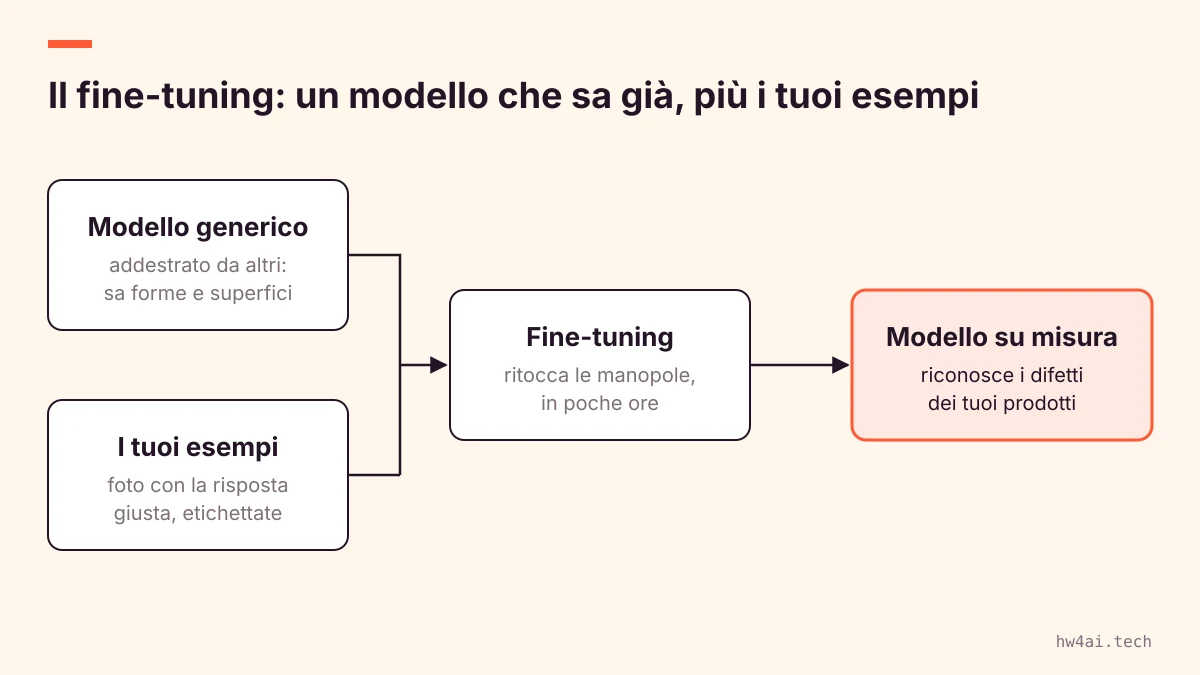
The generic model brings the basics, your examples bring your work: fine-tuning puts them together.
Training from scratch and fine-tuning compared
| Training from scratch | Fine-tuning | |
|---|---|---|
| Starting point | A model that knows nothing | An already trained model |
| Examples needed | Millions, for large models | Hundreds or thousands, your own |
| How long it takes | Weeks or months, for large models | Often a few hours |
| Who does it | Big tech companies and research centres | Your company, the supplier or an integrator |
| Computer needed | Large systems in data centres | Often a single powerful computer in the office |
The values are indicative and depend on the size of the model. A small model, for example one that monitors the vibrations of a motor, can even be trained from scratch on a normal PC.
“Lightweight” fine-tuning
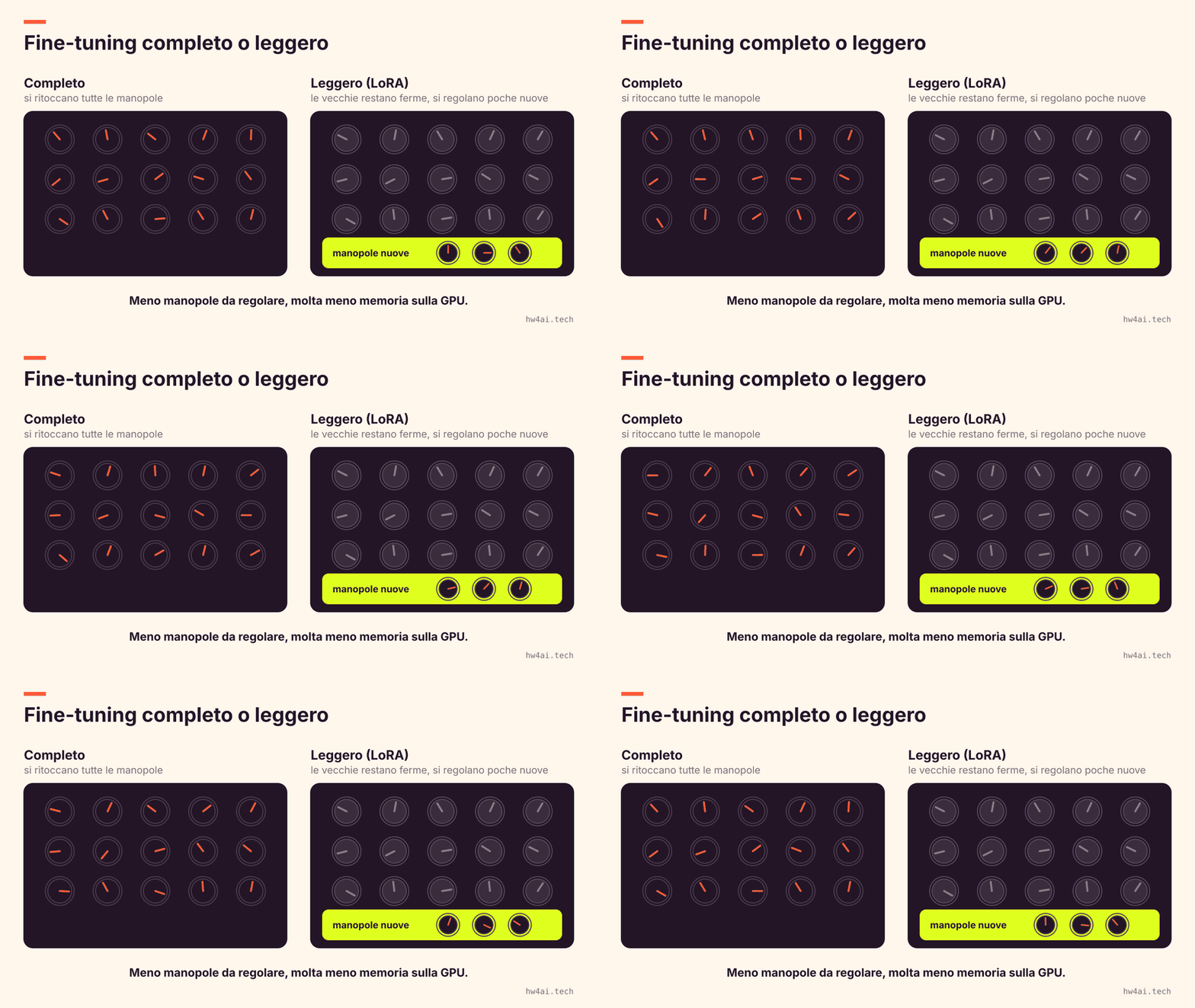
For the largest models there are techniques that make fine-tuning even cheaper. Instead of touching up all the knobs, a few new ones are added and only those are adjusted.
The most widespread technique is called LoRA. In its authors’ tests on a large language model it reduced the knobs to be adjusted by about 10,000 times and the memory needed by three times (Hu et al., 2021). It is one of the reasons why many companies can now do fine-tuning in-house.
When fine-tuning is needed, and when it isn’t
Fine-tuning is needed when you want to change the way the model works. For example:
- recognising the defects of your products, which no generic model has ever seen;
- understanding the technical terms of your sector, such as component codes or shop-floor jargon;
- always answering with the same structure and the same tone, as your company does.
It is not needed, on the other hand, in three very common cases.
When an existing model already does the job well. Before specialising, try. Sometimes it is enough to explain the request properly to the model.
When you want the model to know some information. This is the most common mistake. To make an assistant answer questions about manuals, procedures or price lists you don’t need fine-tuning: the model is given the right documents to read at the moment the question comes in. Specialists call this document search, or RAG. The advantage is huge: if a price list changes, you update the file, not the model.
When you have no examples, or nobody can label them. Fine-tuning learns from your examples with the right answer. Without them, there is nothing to teach.
An easy rule to remember: behaviours are taught with fine-tuning, information is given to read.
An example: the tile factory
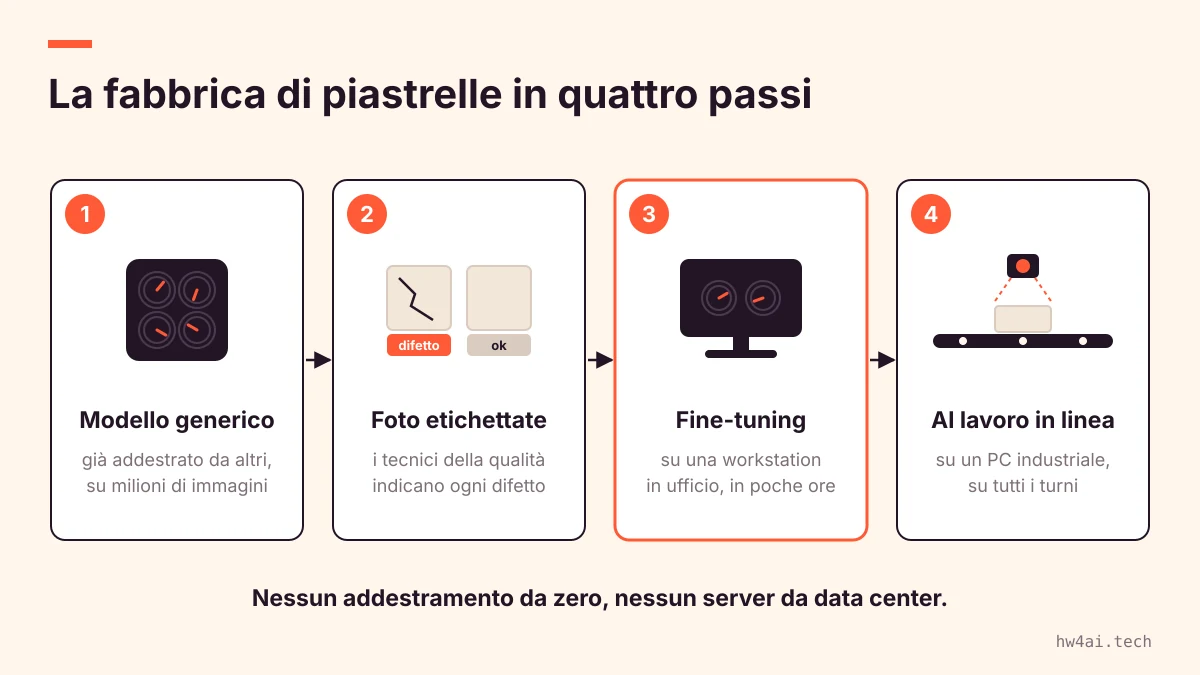
Take a ceramics company (an example, not a real customer) that wants to automatically recognise surface defects on tiles at the end of the line: cracks, stains, chips.
- It doesn’t train anything from scratch. It starts from a vision model already trained by others on millions of generic images. It can already recognise shapes and surfaces, but it doesn’t know what a chip on a tile is.
- It prepares the examples. The quality technicians collect a few thousand photos and, for each one, indicate whether there is a defect and what type. It is the longest job in the project, and it must be scheduled like any other.
- It does the fine-tuning. The model is specialised on those photos, with a powerful computer in the engineering office. It takes hours, not weeks. When a new collection or a new type of defect arrives, it is repeated.
- It puts it to work. The specialised model runs on an industrial computer next to the camera, on the line, across all shifts.
And what if the same company also wanted an assistant that answers the technicians’ questions about the machine manuals? No fine-tuning: information is given to read. All it takes is well-organised manuals and an on-site computer to run the model.
What you need to do fine-tuning in your company
You need three things: examples, people and a suitable computer. The computer is the part people get wrong most often.
The examples. Your photos, your texts, your recordings, each with the right answer. Quality matters more than quantity: wrong examples teach errors.
The people. People who know the trade to label the examples, and someone to run the fine-tuning and check that the specialised model really works. It can be someone in-house or the supplier, but it must be decided beforehand.
The computer. Two words are needed here.
The first is GPU, the graphics card. It was born for video game graphics, but it is excellent at doing a huge number of simple calculations all at once: exactly what is needed to turn millions of knobs. That is why it is the central component of a computer for AI.
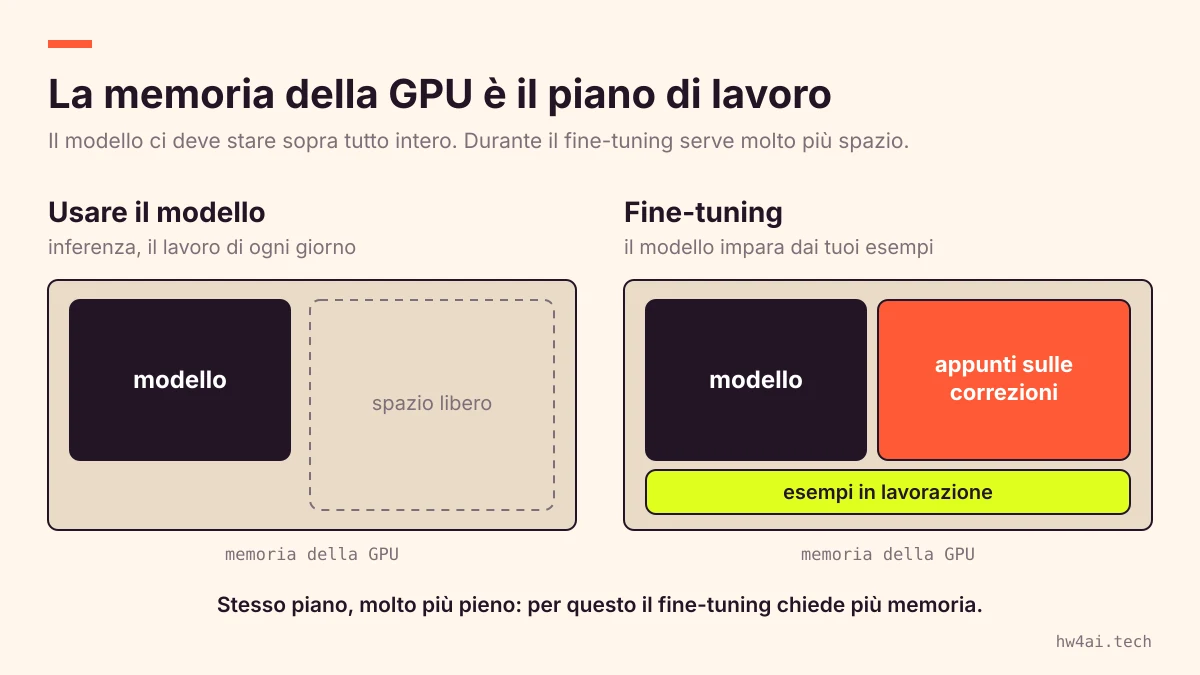
The second is GPU memory. Think of it as the worktop in a kitchen: the whole model has to fit on it, otherwise you can’t work, or you work very slowly. During fine-tuning the worktop fills up more, because next to the model you also need the notes on every correction. That is why specialising a model needs much more memory than using it.
In practice:
- for fine-tuning a workstation is usually enough, that is, a powerful office computer, with a GPU whose memory suits the model;
- for everyday use you often need a different computer, smaller and rugged, close to where the model works;
- if you do fine-tuning in-house, photos, documents and technical drawings don’t leave the company. For many businesses this is the main reason to choose on-premise AI.
The mistake to avoid is buying the computer before you know which model you will specialise and how often. The size of the model decides the memory, and the memory decides the GPU.
Five questions to ask yourself before designing a system with fine-tuning
- Is there already a model that does something similar? Try it before deciding to specialise it.
- Do I need to change the model’s behaviour or give it information? Behaviour: fine-tuning. Information: documents to read.
- Do I have the examples, with the right answer? If not, who will prepare them and how much time do they have?
- How often will I have to repeat the fine-tuning? Once only, or with every new product: this changes the choice between an external service and an in-house computer.
- Can my data leave the company? If not, fine-tuning must be done on premises.
Frequently asked questions about fine-tuning
What is fine-tuning, in simple terms?
It is the specialisation of an artificial intelligence model that has already been trained. You keep training it for a short time, with your own examples, until it learns a specific task: recognising certain defects, using certain vocabulary, answering with a certain structure.
What is the difference between training and fine-tuning?
Training builds a model from scratch, with a huge number of examples and a lot of computation. Fine-tuning starts from a model that already knows the basics and adapts it to your work, with few examples and a few hours of computation.
How many examples does fine-tuning need?
It depends on the task and the model. For many industrial projects we are talking about hundreds or thousands of examples, not millions. What matters most is that they are correct and representative of real cases.
Can fine-tuning be done on a computer in your company?
For many models, yes, especially with lightweight fine-tuning techniques. The decisive factor is GPU memory, which must be chosen according to the size of the model to be specialised.
Do you need fine-tuning to make an AI answer questions about company documents?
Usually not. It is simpler and cheaper to have the model read the relevant documents for each question. And when a document changes, you just update the file.
In short
An artificial intelligence model is a program that learns from examples by adjusting millions of knobs. Training it from scratch is a huge job that almost no company needs to do. Fine-tuning takes a ready-made model and specialises it on your work, with your examples, in a few hours.
It is used to teach a behaviour, not to provide information. And it requires three things: correct examples, people to prepare them, and a computer with enough GPU memory.
Knowing whether you need fine-tuning is the first step. The second is turning it into a concrete machine: which GPU, how much memory, which computer and where to put it.